
May 8, 2025
The core of the S-Series Logistics Support Analysis (LSA) is contained within the S3000L specification. Unlike MIL-STD-1388-2B and GEIA-STD-0007, the S-Series specifications do not define any standard reports. Nevertheless, the ability to visualize your integrated product support (IPS) data is imperative for understanding the true nature of life cycle costs associated with complex engineering systems.
To capitalize on the value behind this data definition, SLICwave LC provides reporting utilities to supplement the S-Series specifications. These tools provide the ability to analyze developed S-Series data from different perspectives. These supplemental reports assist users in quantifying/lowering life cycle costs and promoting interoperability between partnering organizations and S-Series specifications alike.
Each of these reports are uniquely developed by ISS to enhance the inherent value behind the S-Series specifications. Below are a few reports provided with SLICwave LC to support current and future S-Series IPS programs.
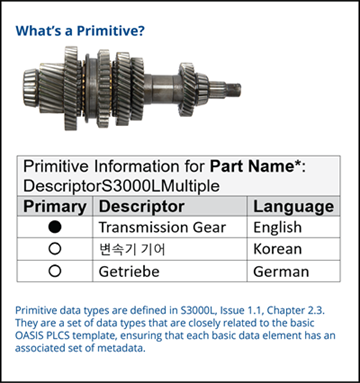
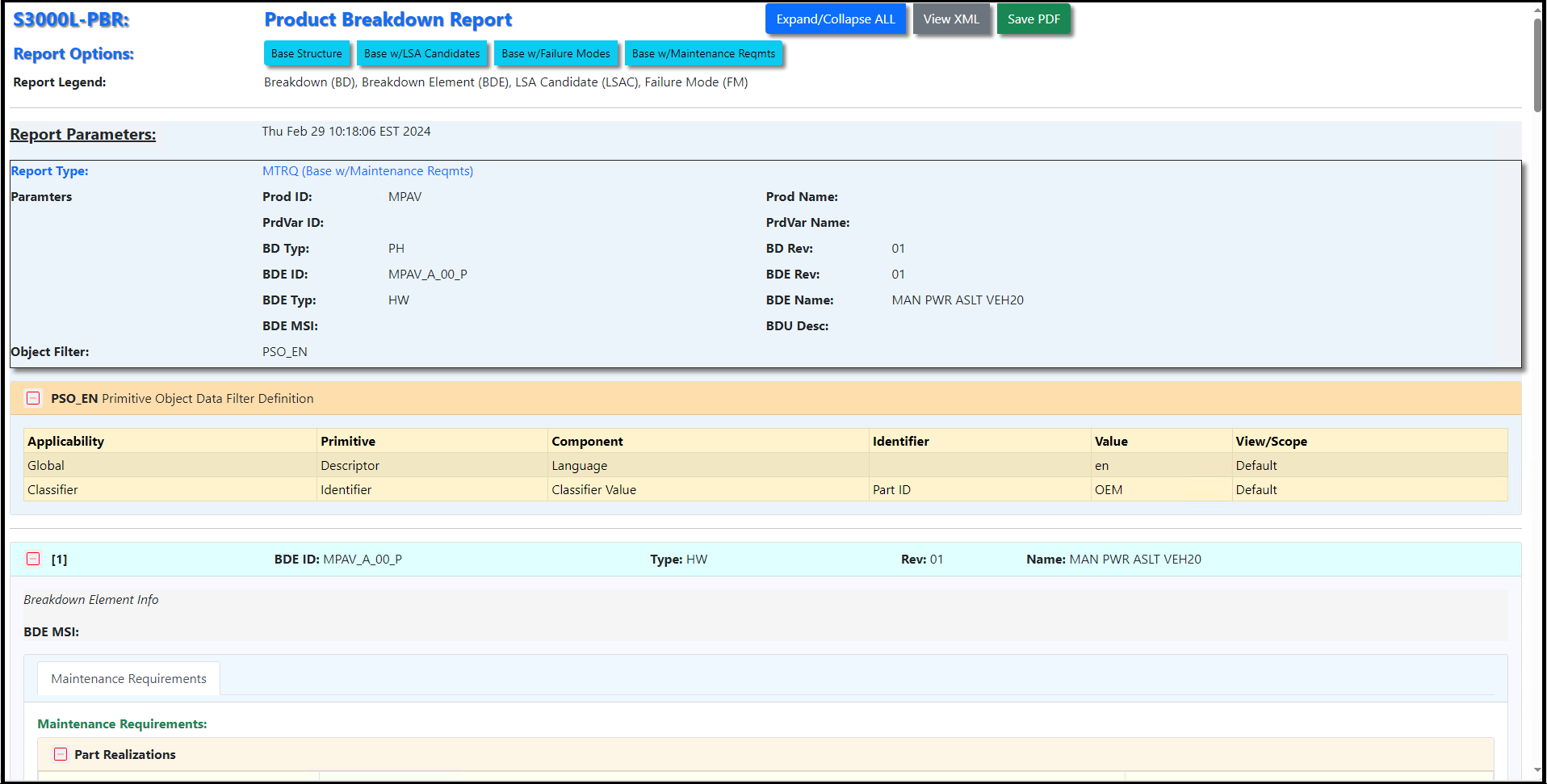
ISS takes advantage of Primitives with all S-Series reporting capabilities. SLICwave LC users can apply object view filters when creating S-Series reports to “pivot” reports by primitive definition. The user simply selects the desired primitive value characterizations from a pick list. These characterizations are then applied as filters for the primitive values output to the report.
With this capability, a user could take advantage of S3000L’s inherent primitive structure to render reports in different languages for example, using the “language characterization” for descriptor type primitives. A report could be generated in English, another in German, and perhaps another in French, by selecting the language characterization as a filter parameter for the report. if all those languages are present within the SLICwave LC database.
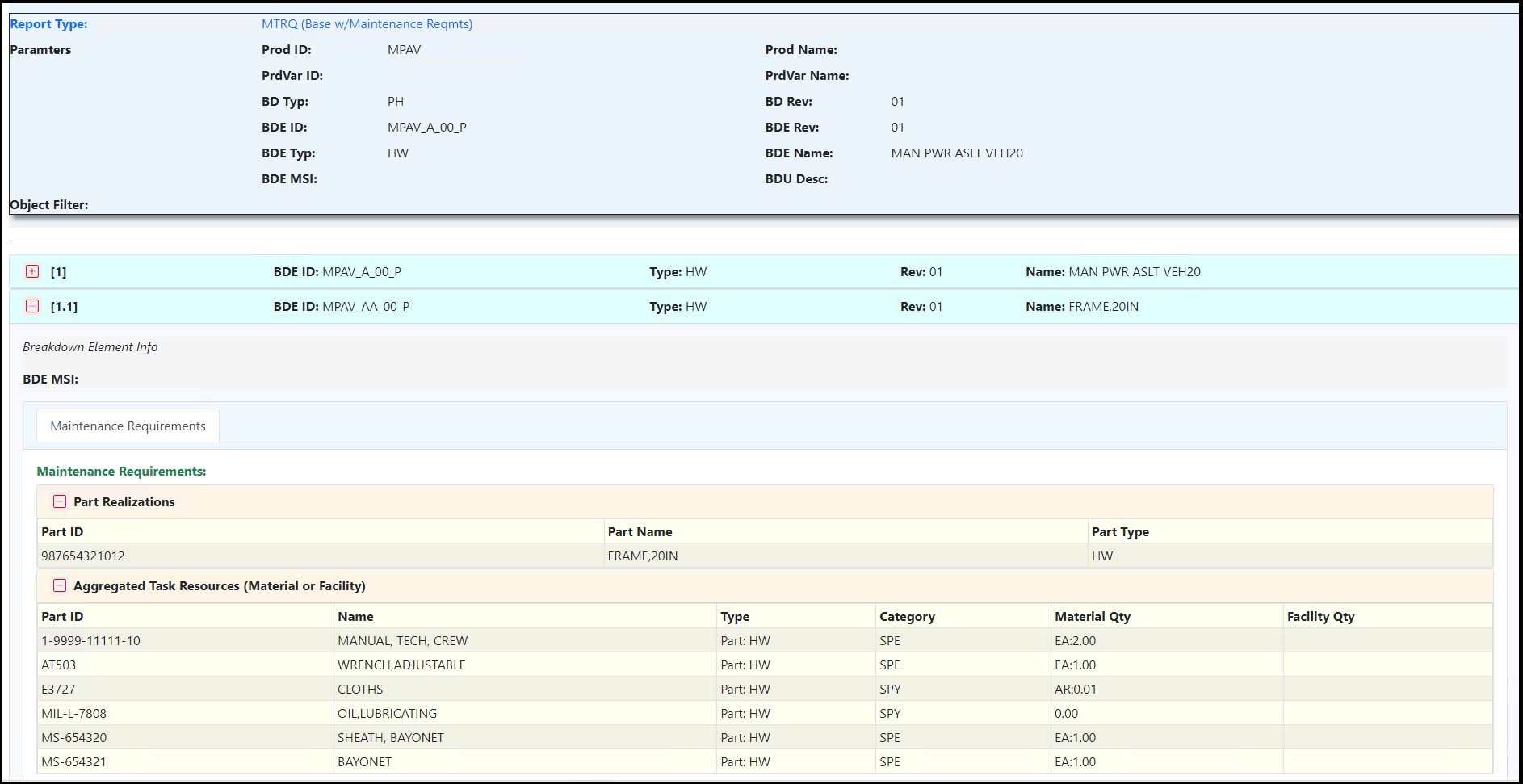
SLICwave LC includes Product Breakdown reports (PBRs) that process data from S3000L Product Breakdown data that may be launched directly from the relevant screen. These reports provide greater visibility into the different elements of IPS required for a defined Product Breakdown. A specific variant of the PBR report supports interoperability between S3000L and S2000M data, by outputting part maintenance requirements for related tasks associated to the breakdown elements within a specified Product Breakdown. The PBR reports output a selected product breakdown along with three variations that incorporate LSA Candidate, Failure Modes, or Maintenance Requirements data, providing analyses from different perspectives.
SLICwave LC includes Parts List Report (PLRs) that provide the ability to review specific sets of S3000L data in the context of a specific Parts List Structure. As with the PBRs above, ISS has included a base report as well as variants to include LSA Candidate, Failure Modes, and Maintenance Requirement options to provide analyses from different perspectives. as will the Product Breakdown Report, the Parts List Report, with related Maintenance Requirements variant is provided specifically to support the S2000M Equipment (Parts) Oriented Provisioning Project creation process using the S3000L Maintenance Task Requirements data.
For those familiar with GEIA-STD-0007’s LSA024 report, ISS delivers a similar report derived solely from S3000L data; the Maintenance Plan Summary Report (MPSR). This report provides both qualitative and quantitative insight about the dataset from a maintenance perspective. This unique report consists of three parts which may be selected together or individually.
For those familiar with GEIA-STD-0007’s LSA019 report, ISS delivers a similar report derived solely from S3000L data, the Task Analysis Report (TAR). This report provides both qualitative and quantitative insight about the dataset from a maintenance perspective. This report consists of three sets of Maintenance Task related data which may be selected together or individually.