September 9, 2025
Effective technical documentation is a vital component of successful defense and military programs. Ensuring that technical documentation contains accurate, authoritative, and up-to-date information can be a difficult and costly undertaking without effective tools. The technical documentation supporting cutting edge and ever evolving systems isn’t just paperwork; it’s a mission-critical asset. That’s where S1000D, the international specification for technical publications, comes in.
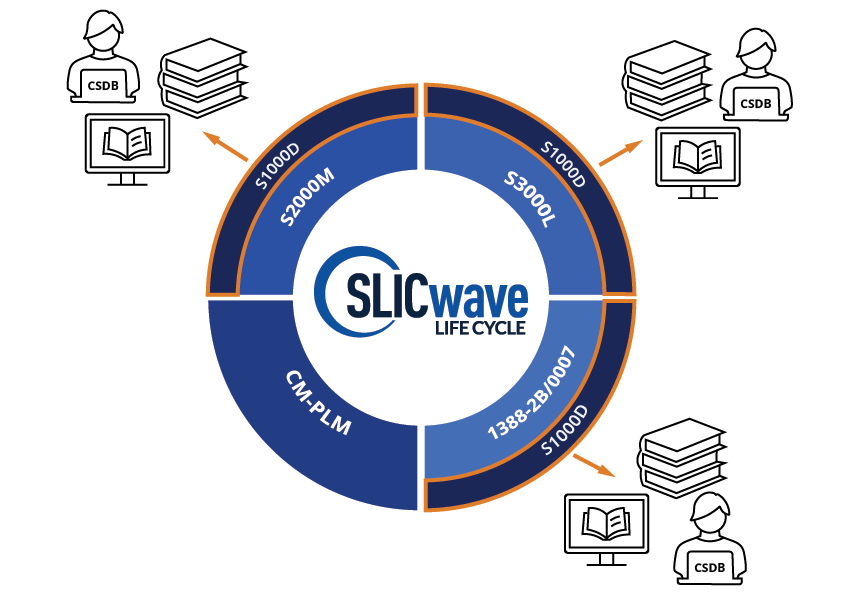
S1000D is an international specification related to the production of technical publications using a Common Source Database (CSDB). Since its inception over 30 years ago, S1000D has become a cornerstone for managing technical documentation for the world of aerospace, defense, and complex systems engineering. Although S1000D is widely adopted today, for many organizations the specification may feel dense, technical, and/or difficult to implement. ISS is committed to realizing the full potential of the standards that SLICwave LC operates based on while assisting others to practically apply and leverage the principles of S1000D for its engineering systems.
The definition of a Data Module (DM) provided in the S1000D Issue 5.0 specification summarizes the purpose of DMs:
A self-contained unit of data for the description, operation, identification of parts or maintenance of the Product and its support equipment. The unit of data consists of an identification and status section and contents section and is produced in such a form that it can be input into and retrieved from a database using the data module code as the identifier.
What this definition leaves out is that DMs are written in an Extensible Markup Language (XML) format. XML is a flexible, text-based scripting language. Therefore, a DM is an XML file used to transmit specific data between contractors and government entities. While the S-Series specifications, like S2000M and S3000L, have ways to transmit LSAR data between data repositories, S1000D DMs are for communicating refined product-related data for technical manuals.
S1000D DMs are flexible and can adapt to varying types and quantities of content. Many portions of DMs can be empty while others can have an infinite amount of data.
There are two main sections in a DM:
A Data Module transmits specific data between contractors or to customers. They communicate refined product data for human use.
Since the IPS data culminates of through-life product support elements (like parts, provisioning, maintenance task analysis, failure data, and so on), these functional areas have a natural relationship to certain S1000D DM types. When sourcing IPS data for reuse with S1000D, the most commonly used DMs are Descriptive, Procedural, and Illustrated Parts Data (IPD) DMs.
For example, the data generated during the IPS process for maintenance task analysis is naturally related to the tasks and subtasks that serve as the foundation for Procedural DMs. These Procedural DMs often form the core of technical manual/Interactive Electronic Technical Manual (IETM) content supporting complex engineering systems.
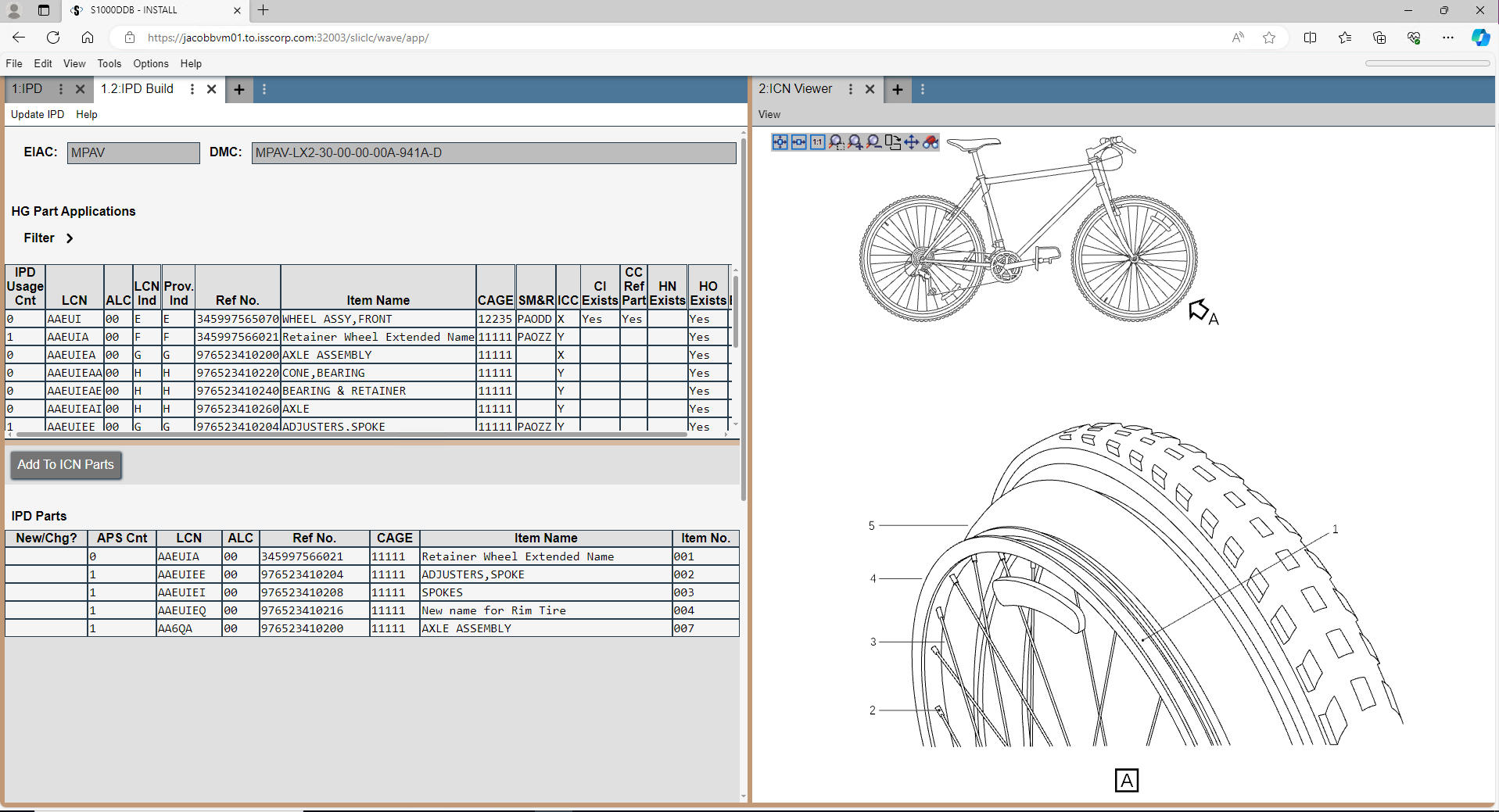
Similarly, provisioning data generated from the IPS process contains relational parts information of complex engineering systems, which is naturally related to IPD DMs. There are 15 categories of DMs defined today in S1000D Issue 5.0. Each has its own set of business rules and structural requirements.
| DM Type | Brief Description |
|---|---|
| Descriptive* | An illustrated functional explanation of the item under analysis. This could include a functional breakdown of the end item or an assembly. |
| Procedural* | An illustrated instructional guide for performing a task on the item under analysis. This could include maintenance tasks. |
| Illustrated Parts Data (IPD)* | Contains the illustrated parts catalog information for the item under analysis. This can include zone information, Catalog Sequence Number (CSN), and Standardized Numbering System (SNS) data, with diagrams linked to part information. |
| Fault Isolation** | A workflow process of identifying a malfunction. There are four fault classifications: Isolated, Detected, Observed, and Correlated faults. |
| Maintenance Planning | Contains scheduled maintenance information. This includes task definitions, inspection definitions, scheduling, and maintenance allocations. |
| Crew information | Contains operational information for the crew of the end item. This includes training drill information, operational procedures, and descriptive information for use by the crew. |
| Wiring data | Represents the wiring data, harness data, electrical equipment data, and standard parts within the Product. |
| Process data | The Process data module can be of any type: procedural, fault, descriptive, and so on. This can include diagnostics, external processes, and logic sequencing. |
| Container data | This DM type is used to associate several alternate data modules representing the same data. For example, multiple DMs achieve the same maintenance goal, but the procedures differ due to product configuration, environment, or other conditions. |
| Learning data | This DM uses the Shareable Content Object Reference Model (SCORM); a set of technical standards for eLearning software products that ensures compatibility between online learning content and Learning Management Systems (LMSs). |
| Maintenance Checklists and Inspections | This DM covers information applicable to inspections, maintenance checks, and more. It is also used to deliver Preventative Maintenance Checks and Services (PMCS) data. |
| Service Bulletins | This DM is used to apply a modification, or a special / temporary inspection of an in-service Product. It is used to notify customers of modification recommendations. |
| Front matter | The content of the front matter depends on the publication media and the content of the publication. The front matter schema minimizes manual authoring and, in most cases, supports auto-generation of the front matter data modules. |
| Shareable Content Objects (SCO) | This DM contains training steps and is a container for SCORM context data. References to external SCO not defined within S1000D data are allowed. |
S1000D transforms how technical information is created, managed, and delivered. This is especially true in the aerospace and defense industries where accuracy, consistency, and long-term support are critical. By breaking content into modular units, technical content can be reused, updated, and repurposed across platforms and products.
Moreover, IPS data encompasses elements like maintenance planning, supply chain logistics, training, and more. S1000D focuses specifically on technical publications using modular, XML-based exchange (DMs) files and end user technical manuals. Although these are separate standards, ensuring IPS and technical publication synergy is imperative for accurate, up-to-date operational and maintenance information.
By exploiting the inherent synergy between the IPS and S1000D data relationship, organizations can reap the foundational benefits associated with:
Integrated Support Systems, Inc. (ISS) offers an assortment of S1000D interface modules for SLICwave LC for a streamlined approach to creation of technical publication data from existing IPS data. The interface modules offer capabilities for repurposing existing source IPS data to seamlessly produce S1000D-compliant XML exchange files as DMS. These DMs then can be easily exported and managed by any S1000D compliant publishing system (e.g., a Common Source Database).